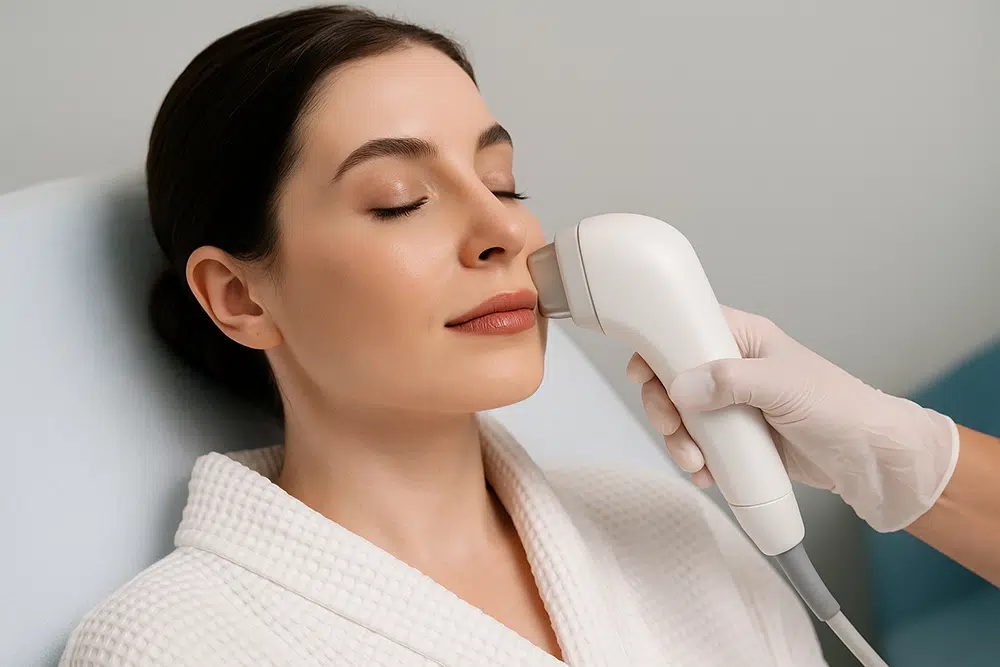
If you want the short answer: Ultherapy is usually the better choice when lifting is the goal — an elevated brow, a tighter under-chin, a firmer neck. Thermage tends to be the pick for overall skin laxity and jawline definition, especially if comfort and the ability to treat larger areas (or the delicate eye area) matter to you.
We can say that with a straight face because Jeune Medspa offers both devices — along with XERF, a newer dual-frequency RF platform, and Oligio, a budget-friendlier Korean RF. Most "Thermage vs Ultherapy" articles are written by practices that own one machine and need to sell it. We would rather help you pick the right one, because the right match is what gives you the best chance of a result you are happy with.
Key Takeaways
- Ultherapy Prime is the lift specialist — brow, under-chin, neck — from $799.
- Thermage FLX is the proven all-rounder for laxity, treating face, eyes, neck, and body from $899.
- XERF is Jeune's newest dual-frequency RF: virtually painless, zero downtime, pricing being finalized.
- On a budget, Oligio RF delivers Korean monopolar RF from $399 for 300 shots.
- The real answer to "which is better" depends on your skin — a complimentary consultation settles it.
How Each One Works: RF Heat vs Micro-Focused Ultrasound
Both treatments do the same job in principle: they deliver energy beneath the surface of your skin to prompt new collagen, which gradually firms and tightens over the following months. The difference is the type of energy — and that difference shapes everything else, from how a session feels to which areas each device handles best.
Thermage FLX: broad radiofrequency heat
Thermage FLX uses monopolar radiofrequency at a single frequency (6.78 MHz) to heat the deeper layers of the skin. Its AccuREP technology tunes the energy pulse by pulse, so each spot receives an appropriate dose rather than a one-size-fits-all blast. You will feel a moderate-to-high heat sensation, softened by built-in vibration and a cryogen cooling spray.
Thermage is a one-session treatment per cycle. Results build gradually, peak around three to six months, and typically last 12 to 24 months. It can treat the face, the delicate eye area, the neck, and the body — and the platform carries more than 20 years of clinical history, which counts for a lot in a field full of newcomers.
Ultherapy Prime: focused ultrasound your provider can see
Ultherapy Prime takes a different route: micro-focused ultrasound. Instead of broadly heating tissue, it delivers precise lines of concentrated energy — and its real-time imaging lets your provider actually see the layer being treated before energy is delivered to it.
That precision is why Ultherapy earned its reputation as a lifting treatment. It is used to lift the brow, tighten under the chin, firm the neck, and smooth lines on the décolletage. New collagen builds over two to three months, and results commonly last a year or more.
Thermage vs Ultherapy: Side-by-Side Comparison
Here is how the two compare at Jeune, where we perform both:
| Thermage FLX | Ultherapy Prime | |
|---|---|---|
| Technology | Monopolar radiofrequency (6.78 MHz) with AccuREP per-pulse energy tuning | Micro-focused ultrasound with real-time imaging of the treatment layer |
| Depth and targeting | Broad, deep heating; treats face, eyes, neck, and body | Precise lines of focused energy delivered to a layer your provider can see on screen |
| Feel and comfort | Moderate-to-high heat sensation, offset by vibration and a cryogen cooling spray | Brief pulses of focused energy, delivered line by line |
| Sessions | One session per treatment cycle | One treatment, sized by lines (300 to 900) |
| Results timeline | Builds gradually, peaking at 3–6 months | Collagen builds over 2–3 months |
| How long results last | Typically 12–24 months | Commonly a year or more |
| Price at Jeune | $899 (300 shots) · $1,299 (600) · $1,499 (900) | $799 (300 lines) · $1,350 (600) · $1,800 (900) |
Prices reflect our current menu. If a larger treatment makes sense for you, Cherry financing lets you split the cost into monthly payments rather than paying everything up front.
Which Should You Choose? Match the Device to Your Concern
After performing both treatments side by side, this is the honest framework we use in consultations.
You want lift: brow, under-chin, or neck
Choose Ultherapy Prime. Focused ultrasound with real-time imaging makes it the specialist for lifting specific structures — a heavier brow, softness under the chin, loose skin along the neck. It is also the one we reach for when décolletage lines are part of the picture.
You want overall tightening — and comfort matters
Choose Thermage FLX or XERF. Thermage covers the widest territory, including the eye area and body, and its two decades of history make it the conservative, well-proven pick. If you are sensitive to heat, XERF's advanced contact cooling makes it the most comfortable monopolar RF we offer — more on that below.
You are budget-conscious or trying non-surgical skin tightening for the first time
Oligio RF is our Korean monopolar RF alternative at a gentler price point: $399 for 300 shots or $749 for 600. We also offer HIFU Shurink, a Korean ultrasound-based option, for patients who want to start smaller before committing to a flagship device.
Whichever direction you lean, spend a few minutes with our before and after gallery — seeing real outcomes on real skin is more useful than any spec sheet. Patients visit us from across north Orange County and nearby cities like Fullerton, Brea, and Whittier, and our approach favors results that look natural rather than dramatic. These devices are well suited to exactly that.
New at Jeune: XERF, a Dual-Frequency RF Alternative
We recently added XERF RF Lifting to our menu, and it changes the conversation for anyone who liked the idea of Thermage but hesitated over the heat. If you have been searching for "XERF vs Thermage," here is the plain-English version.
Both are monopolar RF devices. Thermage runs a single frequency (6.78 MHz). XERF runs two — 6.78 MHz and 2.0 MHz — which allows it to target multiple depths in the same session, including the fibrous septa adjacent to the SMAS layer. Its treatment tip is also about 1.5 times larger than the Thermage FLX tip, so it covers more area with each pulse.
The biggest practical difference is comfort. XERF's advanced contact cooling makes treatment virtually painless, and most patients do not need numbing cream at all. A full-face session takes 45 to 60 minutes, there is zero downtime, and you will notice some immediate tightening that continues to build over three to six months as collagen remodels.
XERF pricing at Jeune is still being finalized. If you are curious whether it fits your goals better than Thermage or Ultherapy, that is exactly the kind of question a complimentary consultation is for — we will assess your skin and give you a straight recommendation, including when a less expensive option would serve you just as well.
Realistic Expectations: What Non-Surgical Tightening Can and Cannot Do
A little honesty goes a long way here. None of these treatments is a facelift, and none will replicate surgical results. What they do well is firm and tighten skin with mild-to-moderate laxity — no incisions, no anesthesia, and no recovery period built around your calendar.
Results vary from person to person. Your age, skin condition, degree of laxity, and how readily your body builds collagen all influence the outcome, which is why we would rather examine your skin before recommending anything. Patience is part of the deal too: collagen remodeling takes months, so the version of your results you will love most typically shows up a season after your appointment, not the next morning.
It is also worth knowing that these results are not permanent. Skin keeps aging, so most patients plan a repeat session once results begin to soften — the typical timelines in the comparison table above are a good guide.
If you are weighing Thermage vs Ultherapy — or wondering whether XERF or Oligio is the smarter fit — book a complimentary consultation at our La Habra studio. We will look at your skin, talk through your budget, and tell you plainly which device we would choose if we were you.
Frequently Asked Questions
Ultherapy vs Thermage: which is better?
Neither is better across the board — they are specialists at different jobs. Ultherapy Prime is typically the stronger choice for lifting the brow, under-chin, and neck, because its focused ultrasound and real-time imaging target a specific layer precisely. Thermage FLX is usually preferred for overall laxity and texture, and it can treat areas Ultherapy is not used for at our studio, like the eye area and body. The honest answer depends on your anatomy, which is what a consultation is for.
How much do Thermage and Ultherapy cost?
Ultherapy Prime is $799 for 300 lines, $1,350 for 600, or $1,800 for 900. Thermage FLX is $899 for 300 shots, $1,299 for 600, or $1,499 for 900, and Oligio RF starts at $399 for 300 shots. XERF pricing is being finalized and is discussed at a complimentary consultation. Cherry financing is available if you would like to split the cost into monthly payments.
Does Thermage hurt?
Thermage produces a moderate-to-high heat sensation, managed with built-in vibration and a cryogen cooling spray. Ultherapy delivers energy in focused lines, and comfort differs by person and treatment area. If you are sensitive to heat, XERF is the most comfortable of the group — its advanced contact cooling makes it virtually painless, usually with no numbing needed.
Is there downtime after Ultherapy or Thermage?
None of these treatments involve incisions or anesthesia, and there is no recovery period built around your calendar. XERF in particular has zero downtime. We will walk you through exactly what to expect at your visit.
How long do the results last?
Thermage FLX results typically last 12 to 24 months after peaking around three to six months. Ultherapy Prime results commonly last a year or more, with collagen building over the first two to three months. Because skin continues to age, most patients repeat treatment once they notice their results softening.
What is the difference between XERF and Thermage?
Both are monopolar radiofrequency treatments, but Thermage uses a single 6.78 MHz frequency while XERF adds a second 2.0 MHz frequency, letting it target multiple depths — including the fibrous septa near the SMAS layer — in one session. XERF also has a treatment tip about 1.5 times larger than Thermage's and advanced contact cooling, which makes it virtually painless for most patients. Thermage's advantage is its track record: more than 20 years of clinical history as a platform.
Do I need a consultation before booking a treatment?
Yes, and ours are complimentary. Skin tightening is not one-size-fits-all, so we assess your skin and goals before recommending a device or a package size. You can book online or call (562) 332-1300 — we are at 721 W. Whittier Blvd, Suite Q in La Habra, open Tuesday, Thursday, Friday, and Saturday from 11am to 7pm.
This article is for general education and is not medical advice. Individual results vary. A complimentary in-person consultation at Jeune Medspa is the best way to find out whether a treatment is right for you.